The Mysterious World of Chameleons: Unveiling Their Unique Adaptations
Chameleons, with their distinctive appearance and remarkable abilities, have captivated the human imagination for centuries. These lizards are known for their vibrant colors, exceptional eyesight, and unique methods of locomotion. Found primarily in Africa, Madagascar, southern Europe, and parts of Asia, chameleons inhabit diverse environments ranging from deserts to rainforests. This article delves into the fascinating world of chameleons, exploring their extraordinary adaptations and the challenges they face in the wild.
A Distinctive Appearance
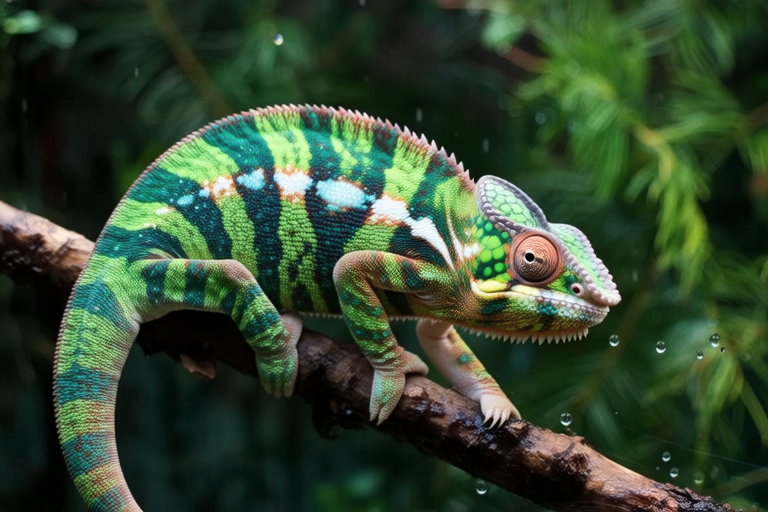
Chameleons are instantly recognizable by their bulging, independently rotating eyes, which allow them to scan their surroundings without moving their heads. Their elongated, prehensile tails help them balance and grip branches, while their feet are uniquely adapted for gripping surfaces. Most chameleon species have zygodactylous feet, meaning they have two toes pointing forward and three backward, or vice versa. This arrangement provides a powerful grip, enabling chameleons to navigate through trees with ease.
The Color-Changing Phenomenon
Perhaps the most famous trait of chameleons is their ability to change color. This adaptation serves multiple purposes, including communication, temperature regulation, and camouflage. The color-changing process occurs when specialized cells called chromatophores expand or contract, altering the wavelengths of light reflected off the chameleon’s skin. These cells contain pigments that shift in response to changes in the environment, such as temperature or light intensity. Additionally, iridophores, another type of cell, reflect light and contribute to the chameleon’s ability to produce a wide range of colors. This mechanism allows chameleons to blend seamlessly into their surroundings, making them nearly invisible to predators and potential mates.
Enhanced Eyesight
Chameleons’ eyes are among the most remarkable features in the animal kingdom. Each eye can rotate up to 180 degrees, allowing the chameleon to see in almost any direction simultaneously. This independent movement enables them to locate prey with precision and avoid danger. When both eyes are focused on the same object, chameleons can judge distance accurately, an essential skill for capturing fast-moving insects. Their exceptional depth perception is further enhanced by a high density of photoreceptor cells in the retina, which provides sharp visual acuity.
Hunting and Feeding
Chameleons are highly efficient hunters, relying on their unique adaptations to catch prey. Their long, sticky tongues can extend up to twice the length of their bodies, allowing them to strike at insects with incredible speed and accuracy. The tongue’s tip is covered in a specialized adhesive substance that traps prey upon contact. Once the tongue retracts, the chameleon swallows its meal whole. Some species have even been observed using their tongues to catch birds and bats. In addition to their tongues, chameleons have sharp, hooked teeth designed for gripping and tearing food.
Movement and Locomotion
Chameleons possess a distinctive method of locomotion that sets them apart from other reptiles. They move by walking slowly and deliberately, using a rocking motion to propel themselves forward. This gait involves lifting one foot at a time and then bringing it down in a precise manner, creating a side-to-side swaying effect. This movement is particularly useful for navigating narrow branches and uneven terrain. Some species also exhibit a more rapid form of locomotion when threatened or fleeing from predators, characterized by quick bursts of speed.
Conservation and Threats
Despite their adaptability, chameleons face numerous threats in the wild, primarily due to habitat loss and fragmentation. Deforestation, urbanization, and agricultural expansion have severely impacted the natural habitats of many chameleon species. As a result, several species are now endangered or critically endangered. Conservation efforts focus on protecting and restoring chameleon habitats, as well as raising awareness about the importance of biodiversity. Organizations and researchers work together to study chameleon populations, monitor their health, and develop strategies to mitigate the effects of climate change and human activities.
Efforts to conserve chameleons also involve captive breeding programs, aimed at increasing population numbers and reintroducing species into the wild. However, these programs must be carefully managed to prevent genetic issues and ensure the survival of future generations. Education plays a crucial role in conservation efforts, as it helps raise awareness about the importance of preserving these fascinating creatures and their ecosystems.
Conclusion
The world of chameleons is a testament to the wonders of evolution and adaptation. From their color-changing abilities to their exceptional eyesight and unique methods of locomotion, chameleons have developed an array of traits that enable them to thrive in diverse environments. However, the challenges they face in the wild highlight the urgent need for conservation efforts. By protecting chameleon habitats and raising awareness about the importance of biodiversity, we can help ensure the survival of these captivating creatures for future generations.
