Debunking Common Myths About Chameleons
Chameleons have long captured the imagination of people worldwide, often appearing in movies, books, and other forms of media. Their unique physical attributes, particularly their ability to change color, have made them a symbol of transformation and adaptability. However, many of the stories and beliefs surrounding these fascinating creatures are rooted in myth rather than fact. In this article, we will explore five common myths about chameleons and provide scientific evidence to dispel these misconceptions. By understanding the truth behind these myths, we can appreciate chameleons for their true characteristics rather than relying on popular culture’s portrayal.
Myth 1: Chameleons Change Color to Match Their Surroundings
The most widely held belief about chameleons is that they change color to blend into their environment. This idea has been perpetuated by countless movies and cartoons, where chameleons are depicted as masters of disguise, perfectly camouflaging themselves against any background. However, scientific research reveals a different story. Chameleons change color primarily for communication and temperature regulation, not for camouflage.
According to a study published in Proceedings of the Royal Society B, chameleons’ color-changing abilities are controlled by specialized cells called chromatophores, which contain pigments that reflect light differently when expanded or contracted. These changes can signal mood, health status, and readiness to mate. For example, a male chameleon may display vibrant colors during courtship displays or darken its skin if it feels threatened. Additionally, chameleons adjust their color to regulate body temperature by absorbing more sunlight or reflecting heat away. Thus, while chameleons can indeed alter their appearance dramatically, it is not for the purpose of blending in with their surroundings.
Myth 2: All Chameleons Can Shoot Tongues at Prey
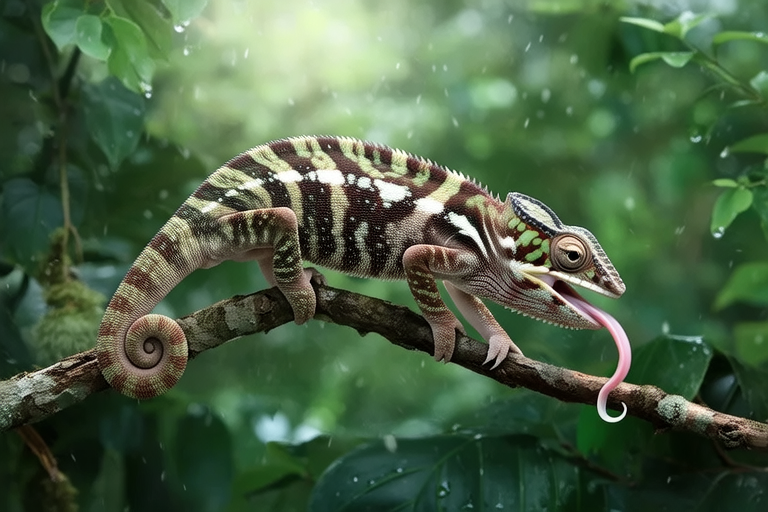
Another enduring myth about chameleons is that every species possesses the remarkable ability to shoot out their tongues to catch prey. While it is true that some chameleons have this impressive adaptation, not all do. The tongue-shooting mechanism is most prevalent among arboreal species, which rely heavily on insects for sustenance. Ground-dwelling chameleons, such as the Oustalet’s chameleon, typically lack this feature because their diet consists mainly of vegetation.
Research conducted by scientists at the University of California, Berkeley, revealed that the evolution of the ballistic tongue occurred independently multiple times within the chameleon family tree. This adaptation allows certain species to extend their reach up to twice their body length, enabling them to capture flying insects from great distances. However, other chameleon species have shorter tongues relative to their body size and must rely on different hunting strategies, such as stalking prey or using their keen eyesight to ambush unsuspecting victims. Therefore, while the tongue-shooting ability is a hallmark of many chameleons, it is not universal across all species.
Myth 3: Chameleons Have the Best Eyesight in the Animal Kingdom
Chameleons are often portrayed as having exceptional vision, with some sources claiming they possess the best eyesight in the animal kingdom. Although chameleons do have remarkable visual capabilities, this claim is exaggerated. Their eyes can rotate independently, allowing them to scan their environment for potential threats or food sources without moving their head. This unique feature gives chameleons a nearly 360-degree field of view, which is certainly impressive but does not make their eyesight superior to that of other animals.
A comparative study published in Animal Cognition found that while chameleons excel at detecting motion and depth perception due to their binocular vision (the ability to see objects with both eyes simultaneously), their acuity is comparable to that of birds and mammals. Some nocturnal predators, like owls, have sharper night vision, while certain birds of prey can spot small prey from much greater distances. Thus, while chameleons have excellent eyesight suited for their lifestyle, they do not hold the title for best eyesight in the animal kingdom.
Myth 4: Chameleons Only Live in Tropical Rainforests
Many people believe that chameleons exclusively inhabit tropical rainforests, where they are often depicted in nature documentaries and wildlife shows. While it is true that several chameleon species thrive in dense, humid environments, others are adapted to various habitats, including deserts, savannas, and even mountainous regions. The diversity of chameleon habitats underscores the adaptability of these reptiles.
A comprehensive survey of chameleon distribution conducted by researchers at the University of Zurich revealed that approximately 75% of known chameleon species reside in Madagascar, an island nation renowned for its rich biodiversity. However, other species can be found across Africa, southern Europe, and parts of Asia. For instance, the Veiled chameleon (Chamaeleo calyptratus) is native to arid regions of Yemen and Saudi Arabia, thriving in dry, rocky landscapes. Similarly, the Jackson’s chameleon (Trioceros jacksonii) inhabits high-altitude forests in Kenya and Tanzania, showcasing the wide range of environments where chameleons can flourish. Consequently, while tropical rainforests are home to numerous chameleon species, they are not the sole habitat for these versatile reptiles.
Myth 5: Chameleons Are Harmless and Make Good Pets
Chameleons are frequently marketed as low-maintenance pets suitable for beginners, thanks to their intriguing appearance and relatively simple care requirements. However, owning a chameleon requires careful consideration and commitment. Many species have specific dietary needs, temperature preferences, and humidity levels that must be met to ensure their well-being. Moreover, some chameleon species, especially those native to Madagascar, are endangered due to habitat destruction and illegal pet trade.
Experts recommend that potential chameleon owners conduct thorough research before making a decision. They should familiarize themselves with the species’ natural habitat, feeding habits, and social behaviors. It is also crucial to source chameleons from reputable breeders rather than wild-caught specimens, as the latter often suffer from stress, malnutrition, and disease. Additionally, responsible pet ownership involves providing appropriate enclosures, proper lighting, and regular veterinary check-ups. By educating oneself about the complexities of chameleon care, one can better understand whether these captivating reptiles are the right choice for a pet.
Conclusion
As we have explored, many of the myths surrounding chameleons stem from misconceptions and oversimplifications. From their color-changing abilities to their habitats and interactions with humans, chameleons are far more complex and interesting than popular culture suggests. By learning the truth behind these myths, we can develop a deeper appreciation for these remarkable creatures and recognize the importance of preserving their natural habitats.
We encourage readers to visit local zoos, aquariums, or wildlife centers to observe chameleons in person. These institutions offer educational programs and exhibits that highlight the diversity and uniqueness of chameleon species. Additionally, supporting conservation efforts through donations or volunteer work can help protect these fascinating reptiles for future generations. Let us celebrate chameleons for their true characteristics—color-changing marvels, skilled hunters, and adaptable survivors—rather than relying on the myths that have shaped our perceptions.
